Building a custom home is an opportunity to create a living space that reflects your lifestyle, design preferences, and long-term goals. From selecting the right floor plan to choosing energy-efficient materials, every decision influences how comfortable, functional, and sustainable your home will be.
However, choosing the right builder is just as important as deciding on the design. With different building companies offering different approaches, services, and construction methods, homeowners need to look beyond the initial quote and consider experience, workmanship, communication, and long-term performance.
If you are searching for custom home builders in Brisbane, understanding what to look for can help you make an informed decision and move forward with greater confidence. This guide explains the essential factors to consider when choosing a builder for your new home in Brisbane, Queensland, drawn from our 14 years of building and renovating homes across Brisbane, from Tingalpa and Tarragindi to Yeronga and Mount Gravatt.
Why Choose a Custom Home Builder in Brisbane?
A custom-built home gives you greater control over the layout, materials, features, and overall design than a standard project home. Rather than adapting your lifestyle to a predetermined floor plan, you can work with a builder to create a home that suits your family’s needs and the characteristics of your property.
Brisbane’s subtropical climate also makes thoughtful home design particularly important. Hot summers, humidity, seasonal rainfall, and changing weather conditions can influence decisions about ventilation, insulation, shading, windows, and building materials.
Brisbane blocks bring their own challenges too. Sloping sites, reactive clay soils, flood overlays and council minimum floor levels can all affect foundations, retaining walls and cost. A builder who knows local site conditions will flag these early, before they turn into expensive variations.
An experienced custom home builder can help incorporate these considerations into the planning process while balancing appearance, comfort, durability, and construction costs.
For homeowners who value long-term performance, it is worth considering builders who understand energy-efficient design, passive house principles and building science alongside traditional construction quality.
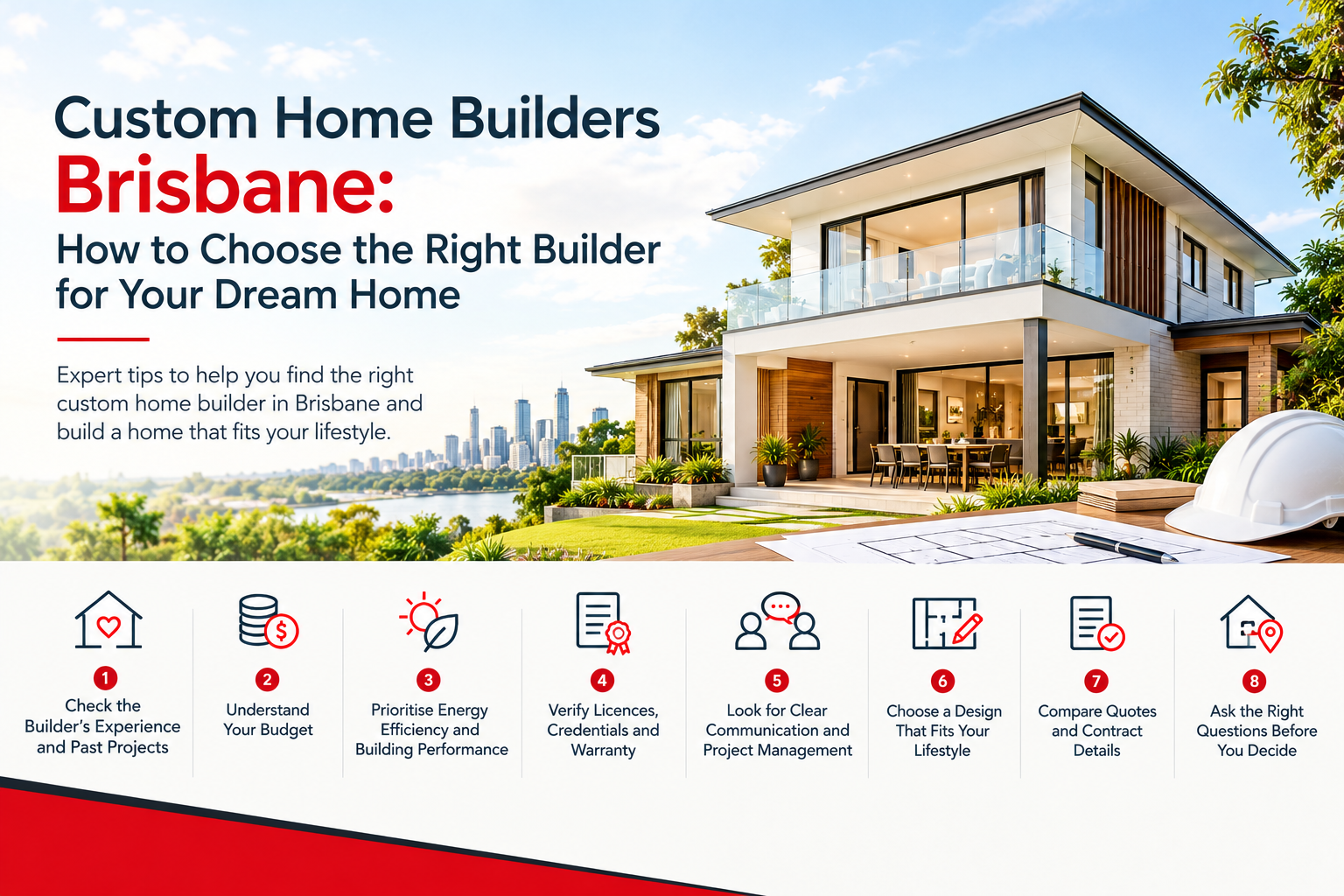
1. Review the Builder’s Experience and Previous Projects
The first step in choosing a custom home builder is to examine their experience and completed projects. A professional portfolio can help you understand the builder’s design approach, attention to detail, material choices, and ability to deliver different types of homes.
Look for projects that demonstrate:
- Well-planned layouts and practical use of space.
- Quality finishes and carefully executed details.
- Designs that respond to the property’s orientation and surroundings.
- Suitable materials and construction methods for Brisbane’s climate.
- A consistent approach to quality and project delivery.
Do not rely on photographs alone. Ask whether you can view a completed property, speak with previous clients, or learn more about how the builder managed a similar project.
You should also check customer reviews and look for consistent feedback about communication, workmanship, scheduling, and how problems were resolved.
Industry awards are another useful guide. HIA and Master Builders awards are judged independently on workmanship, project delivery and business practices, so a consistent track record of wins says a lot about a builder.
2. Understand Your Budget Before Comparing Builders
Budget planning is an essential part of building a custom home. The final cost depends on several factors, including the size of the property, site conditions, architectural complexity, material specifications, labour, and the features included in the design.
Before requesting quotes, establish a realistic budget and communicate your priorities clearly.
When comparing proposals from custom home builders in Brisbane, request quotes based on the same set of plans and specifications, then check whether the quoted price includes:
- Design and documentation fees.
- Site preparation and relevant soil testing.
- Site-specific costs such as excavation, retaining walls and flood level requirements.
- Structural work and building materials.
- Windows, doors, insulation, and finishes.
- Plumbing, electrical work, and other services.
- Required approvals, inspections, and applicable fees.
- Landscaping, driveways, and external works, if required.
The lowest quote may not represent the best overall value. A proposal that excludes important work or allows for lower-grade materials could lead to additional costs later.
Ask each builder to explain exclusions, allowances, provisional sums, and how variations will be priced. Keeping a contingency in your budget can also help you manage unexpected site conditions or changes to your requirements.
3. Prioritise Energy Efficiency, Healthy Homes and Building Performance
A well-designed custom home should offer more than attractive interiors. It should also provide comfortable indoor temperatures, good ventilation, healthy indoor air and efficient energy use throughout the year.
Brisbane’s climate makes these considerations especially relevant. Brisbane sits in Climate Zone 2, with warm, humid summers and mild winters, so effective cooling is the priority. A home that overheats during summer or relies heavily on mechanical cooling may be less comfortable and more expensive to operate.
The best results come from passive house principles: treating the thermal envelope, airtightness, ventilation and solar orientation as one system rather than as separate add-ons.
When assessing a builder, ask how they approach the following design elements.
Solar orientation and natural light
The positioning of a home affects how much direct sunlight enters different rooms throughout the day. Thoughtful orientation can help capture useful winter sunlight while limiting unwanted summer heat. In Brisbane, north-facing living areas with correctly sized eaves are a simple, low-cost way to do this.
Insulation and thermal performance
Suitable insulation and a well-designed building envelope help reduce heat transfer between indoor and outdoor environments. This can support more stable indoor temperatures and improve comfort.
Airtightness and weather barriers
Uncontrolled air leaks through gaps in walls, floors and ceilings can undo the work of good insulation, letting hot, humid air in and conditioned air out. A high-performance weather-resistive and airtightness membrane, such as Pro Clima wrap, installed behind the cladding helps control air movement and moisture, improving durability and energy efficiency.
High-performance windows and doors
Window placement, glazing specifications, insulated frames, and external shading can influence heat gain, daylight, and ventilation. These elements should be considered as part of the overall design rather than selected independently.
Shading and passive cooling
Eaves, external blinds, louvres, and appropriately positioned openings can help reduce solar heat gain and encourage natural airflow when conditions allow. Lighter roof and wall colours also help, as darker colours absorb heat during the day and release it into the home at night.
Ventilation and indoor air quality
Good ventilation helps manage indoor humidity, odours, and airborne pollutants. Depending on the home’s design and the occupants’ needs, a builder may recommend natural ventilation, mechanical ventilation, or a combination of approaches. The more airtight a home is, the more important a planned ventilation strategy becomes.
Healthy, low-emission materials
Paints, cabinetry, adhesives and flooring can release VOCs (volatile organic compounds) into the home for months after completion. Ask your builder about low-VOC paints and E1 or lower-emission board products for cabinetry, which reduce off-gassing and support a healthier indoor environment.
When comparing custom home builders in Brisbane, ask for specific examples of how they incorporate energy-efficient principles into their projects. This makes it easier to assess whether a builder’s approach aligns with your expectations for comfort and long-term performance.
4. Check Building Licences, Credentials, and Warranty Arrangements
Before signing an agreement, verify that the builder holds the appropriate licence for the proposed work. In Queensland, the Queensland Building and Construction Commission (QBCC) provides resources for checking contractor licences and understanding homeowner protections.
You should also ask about relevant qualifications, industry accreditations (such as HIA GreenSmart for energy-efficient building), insurance, and the builder’s experience with projects similar to yours.
Review the proposed contract carefully and make sure it clearly explains the agreed scope, specifications, price, payment arrangements, project stages, and procedures for handling changes.
For applicable residential construction projects, ask how Queensland Home Warranty Scheme requirements will be addressed, and what structural and maintenance warranties the builder provides after handover.
Taking these steps before committing to a builder helps reduce uncertainty and gives you a clearer understanding of your rights and responsibilities.
5. Look for Clear Communication and Project Management
Building a custom home involves numerous decisions, from design approvals and material selections to construction milestones and final inspections. Clear communication can make this process easier to manage.
During your initial discussions, assess how the builder answers questions and explains technical information. You should understand who your main contact will be, how frequently updates will be provided, and how decisions or unexpected issues will be communicated.
Ask questions such as:
- Who will manage my project from start to completion?
- How will I receive progress updates?
- How quickly will you respond to my calls and emails?
- Can I see my selections, budget and variations online at any time?
- How are changes to the design or specifications approved?
- What happens if materials are delayed or site conditions change?
- How will defects or concerns be addressed?
- What support is available after handover?
A structured project management process helps establish realistic expectations and makes it easier to identify potential issues before they become larger problems.
6. Choose a Design That Fits Your Lifestyle and Future Needs
A custom home should reflect how you live today while allowing room for your needs to change over time.
For example, a growing family may need flexible bedrooms and additional storage, while homeowners working remotely may prioritise a quiet office. Open-plan living areas, accessible entryways, outdoor entertaining spaces, and energy-efficient systems may also influence your design choices.
Consider how each room will be used, how people will move through the home, and whether the layout supports privacy as well as shared activities.
It is also worth considering future maintenance. Durable materials, practical storage, accessible service areas, and well-planned landscaping can help make the property easier to maintain.
Discuss these priorities with your builder early. The earlier your requirements are incorporated into the design, the easier it is to assess their effect on the budget and construction plan.
7. Understand the Contract Type and How Variations Are Handled
Once you have shortlisted a builder, look closely at the type of contract on offer. A fixed price contract locks in the agreed price for the agreed scope, giving you far more certainty than a cost plus arrangement, where the final price depends on actual costs incurred.
Check how many provisional sums and prime cost allowances are in the contract. These are estimates for items not yet fully selected or priced, and a contract with lots of them carries more risk of the price moving. Also ask how variations are priced, including any administration fee, and how they are approved.
Before signing, confirm the expected start date, estimated construction period, payment schedule, and process for approving variations.
Read the contract and associated documents carefully. If anything is unclear, seek independent professional advice before proceeding.
The QBCC recommends checking a builder’s licence, reviewing the contract documents, and understanding the terms before committing to residential building work. You can find guidance through the Queensland Building and Construction Commission.
A transparent agreement provides a clearer foundation for the working relationship and helps both parties understand what has been agreed.
Why Build Your Custom Home with RedKem?
RedKem Constructions has been building and renovating homes across Brisbane for 14 years, and high-performing, healthy homes are what we do best. As a GreenSmart accredited builder, we design and build around passive house principles: a well-insulated thermal envelope, airtightness, controlled ventilation and smart solar orientation. The result is a home that stays comfortable year-round with dramatically lower energy bills.
We are a small team by choice. Jared Kemp (Director/Building Manager) and Craig Minty (Project Manager) are hands-on with every project, and we limit how many we take on so yours gets our full attention.
What you can expect:
- Fixed price contracts with no hidden extras.
- 24/7 online access to your selections, budget, variations, schedule and photos.
- A response to every call or email within 24 hours.
- A 6.5 year structural warranty and 12 month maintenance period.
- If you’re not 100% satisfied, a licensed defect inspection with all defects rectified within 4 weeks, guaranteed.
Our work has been recognised with HIA Queensland Small Building Company of the Year in 2015, 2018, 2019 and 2020, along with multiple renovation awards. See our full list on our awards page. We are proud members of Master Builders Queensland and HIA, and hold QBCC licence 1278992.
Explore our approach to high-performing homes on our Custom Homes page.
Questions to Ask Custom Home Builders in Brisbane
Before making your final decision, use these questions to guide your conversations with shortlisted builders:
- Are you appropriately licensed for my proposed building project?
- Can I review completed projects and speak with previous clients?
- What is included in the quote, and what costs are excluded?
- Is the contract fixed price, and how many provisional sums does it include?
- How do you approach energy efficiency, airtightness and thermal comfort?
- Who will manage my project and provide progress updates?
- What is the expected construction timeline?
- How are variations, delays, and unexpected costs managed?
- What warranties and post-handover support apply?
The answers will help you compare builders on more than price alone and determine which company best suits your requirements.
Conclusion
Choosing the right builder is one of the most important decisions you will make when planning a custom home. The best choice depends on a combination of experience, transparent pricing, construction quality, effective communication, and an understanding of your design priorities.
For homeowners researching custom home builders in Brisbane, it is also worth looking beyond the initial appearance of a property and considering how its orientation, insulation, airtightness, windows, ventilation, and materials may affect comfort and energy use over time.
Take time to compare written quotes, check licences, review previous work, and understand the contract before committing. If energy efficiency and healthy indoor environments are priorities, explore builders who can explain how these principles are incorporated into their designs.
If you are planning a custom home in Brisbane and want it to be comfortable, healthy and cheap to run, we would love to hear about your block, your design ideas and your budget. Call RedKem Constructions on 1300 002 102, email jared@redkem.com.au or book a consultation through our Custom Homes page.